



Guest User
Login
#0 Rank0 Coins
Dashboard
 Notification
 Coins
CoinsGames Categories
 New Games
Connect with us



 sports
 action
 cricket
 arcade
 racing
 adventure
 girls
girls boys
boys hot
hot moresportsactioncricketarcaderacingadventuregirlsboyshotmore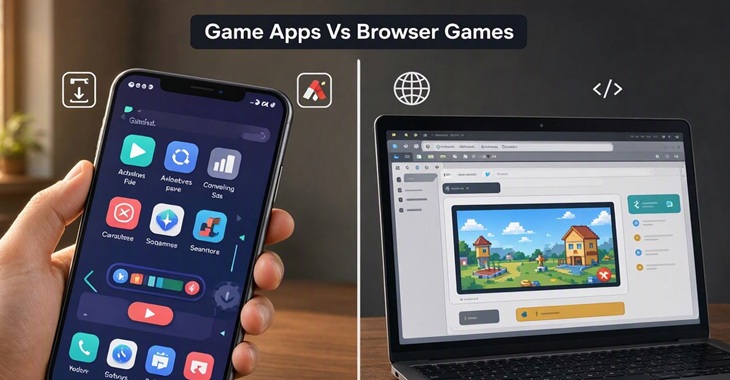
Casual gaming in 2026 is less about owning a game and more about getting into a game quickly. A few free minutes can be enough for a puzzle, cricket match, racing round or arcade challenge. That is where the difference between mobile apps and browser games becomes noticeable.
Mobile game apps still offer strong performance, offline features and deeper device integration. Browser games take a different route: open a webpage, let the game load and start playing. Modern web technology is capable of much more than the simple games associated with the old Flash era. Current browsers support graphics, audio, touch input, networking and other features needed for proper gaming.
Browser Games Have the Convenience Factor:
For casual players, convenience can matter more than having the most advanced graphics.
A browser game does not normally require an app-store installation. That makes it easier to test a new title without committing storage space to it.
This is useful for games such as:
Puzzle and board games
Simple sports games
Endless runners
Card games
Arcade challenges
Short multiplayer games
There is also less clutter on the phone. Once the gaming session is over, the browser tab can simply be closed.
Mobile Apps Still Have Important Advantages:
Mobile apps are not going away. They remain the better fit for games that need serious hardware performance or large amounts of locally stored content.
An installed game can make extensive use of the device's graphics processor, storage, vibration, sensors and other platform features. Offline play can also be more reliable because much of the required content is already on the device.
For a player who spends several hours with the same game, those advantages can outweigh the convenience of browser access.
2026 Is Putting More Attention on Low-Friction Gaming:
There is a practical reason browser gaming continues to attract attention. A recent 2026 web-gaming study from Poki found that players are increasingly sensitive to friction such as long loading times and large downloads. In its survey, 46% of web gamers said they had stopped playing a mobile game because it took too long to open or load, while 28% stopped because the download was too large.
That does not mean every player prefers browser games. It does show why quick access matters.
Casual gaming is built around short decisions: play now or do something else. Every extra step can affect that choice.
Browser Gaming Is Not Just Basic 2D Gaming:
The old idea that browser games are limited to simple animations no longer holds up.
HTML5 games can use technologies including WebGL for graphics, Web Audio for sound, WebSockets or WebRTC for networking, and browser APIs for touch and controller input.
This opens the door to more varied experiences. Browser games can now cover 2D action, multiplayer titles, sports games and some demanding 3D experiences.
That does not put every browser game on the same level as a large native release. It simply means the gap is not as wide as it once was.
Apps Make More Sense for Long-Term Gaming:
Mobile apps usually win when a game is designed to become a regular part of a player's routine.
An installed game can support:
Large downloadable content
Detailed graphics
Offline modes
Persistent notifications
Deeper device integration
More complex progression systems
There is also a psychological difference. Once a game is installed, it is always sitting on the home screen, ready for another session.
That can be useful for players who return to the same game every day.
Browser Games Work Well for Short Sessions:
Browser gaming has a natural advantage when the session itself is short.
A five-minute game does not necessarily need a huge installation, a complicated account setup or a long tutorial. The format works especially well when the objective is straightforward: complete a level, beat a score, solve a puzzle or finish a quick match.
This is one reason web games continue to fit the casual market. MDN describes HTML games as particularly suitable for experiences that can be played across mobile devices and other platforms, including quick “time killer” style games.
A Quick Comparison for Casual Players:
Feature | Browser Games | Mobile Apps |
Storage | Generally lighter | Can require significant space |
Installation | Usually not needed | Required |
Offline play | Depends on the game | Usually stronger |
Quick sessions | Excellent fit | Good |
Device features | More limited | Deeper access |
Graphics | Good to very good | Better for demanding titles |
Cross-device use | Strong | More platform-specific |
Updates | Often delivered through the website | Usually app-based |
Best for | Casual, quick sessions | Regular and longer gaming |
Updates Are Another Difference:
Web games have a useful advantage when developers need to push changes quickly. The game files can be updated on the server, so players can receive a new version when the page loads.
Native apps have a different process. Updates are normally distributed through an app store, although games can also download additional content after installation.
For developers, the web can therefore be a flexible distribution channel. MDN highlights direct distribution and the ability to update web games without relying on traditional app-store approval as important advantages.
Which Option Uses Less Commitment?
This is where browser games have a particularly strong case.
Installing an app is a small commitment, but casual gaming often does not need one. A browser title can be tested, played and forgotten without taking up a permanent place in the app library.
That is useful when players regularly switch between different games instead of following one title for months.
Mobile apps, on the other hand, are better suited to games that benefit from long-term progression and regular play.
Frequently Asked Questions (FAQs):
Q1. Do browser games work on smartphones in 2026?
A1. Yes. Modern web technologies support mobile browsers, touch controls, graphics, sound and networking. Actual performance depends on the game, browser and device.
Q2. Are browser games better than mobile apps for casual gaming?
A2. For quick sessions, browser games can be more convenient because they usually do not require installation. Mobile apps are often better when performance, offline play or deeper device features matter.
Q3. Which is better for offline casual gaming?
A3. A mobile app usually has the advantage because game content can be stored locally. Browser games can support offline functionality, but it depends on how the individual game was developed.
Q4. Are browser games faster than mobile apps?
A4. Not automatically. A lightweight browser game may start very quickly, but a large or poorly optimised web game can still take time to load.
The Better Choice Depends on the Gaming Habit:
There is no universal winner in the browser-versus-app debate.
For a player who wants quick access, minimal storage use and a game that can be opened whenever there is spare time, browser gaming is a sensible choice. For someone who wants high-end graphics, offline access and a game that becomes part of a daily routine, a mobile app is usually more suitable.
In 2026, the difference is less about what the technology can do and more about what the player actually needs. Browser games have become capable enough to handle serious casual gaming, while mobile apps continue to lead when deeper performance and device integration are the priority.
For casual gaming, less friction can be just as valuable as more features.
Atmegame.com is a completely new platform for the online games lovers.The best part is that all games available on our website are free and can be enjoyable on multiple devices, including desktop, mobile phones, tablets, and iPhones or iPads.
