



Guest User
Login
#0 Rank0 Coins
Dashboard
 Notification
 Coins
Games Categories
 New Games
Connect with us



 sports
 action
 cricket
 arcade
 racing
 adventure
 girls
 boys
 hot
 moresportsactioncricketarcaderacingadventuregirlsboyshotmore
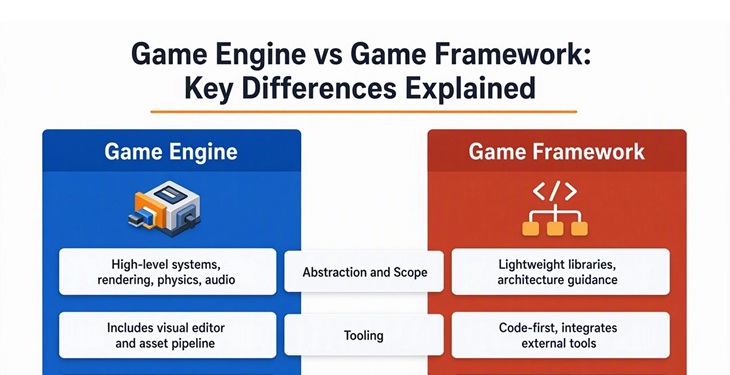
Game engines and game frameworks both help developers build games, but they offer different levels of built-in functionality. A game engine typically combines tools for graphics, physics, animation, audio, scripting and testing in one development environment. A game framework provides a collection of libraries and APIs that developers use to build these systems into a working game.
The main difference between a game engine and a game framework is how much of the development environment and supporting systems are already integrated.
Understanding that distinction can help you choose the right tool for your project's scope, your programming experience and your target platform.
A game engine is a larger development package. It normally combines tools for graphics, physics, audio, animation, input, scenes, scripting and debugging in one environment.
Unity, Unreal Engine and Godot are common examples.
Godot, for instance, describes itself as a complete 2D and 3D engine with tools for creating and exporting games to desktop, mobile and web platforms.
A developer can therefore spend more time working on the actual game instead of creating basic systems from scratch.
A game framework sits closer to the programming side of development.
It provides code libraries and structures for common game tasks, but it generally leaves more decisions in the hands of the developer. There may not be a large editor with every tool already arranged in one place.
A framework might provide support for:
Rendering
Input handling
Audio
Game loops
Basic physics
Asset management
Window and screen management
The developer then builds the rest of the architecture around those parts.
This approach can take longer, but it also gives experienced programmers more control over how the game is organised.
The simplest comparison is this:
Engine = more ready-made systems.
Framework = more freedom to build the systems around the available tools.
That does not mean an engine removes programming. Developers still write gameplay code, design systems and make countless technical decisions.
For example, Unreal Engine also has a system called the Gameplay Framework, which includes classes and systems for managing gameplay, players, pawns, controllers and game modes. This is part of Unreal Engine itself, rather than an example of a standalone game framework. It shows that a full engine can provide structured systems while still allowing developers to customize their games.
A frameworks generally provide a more focused set of APIs and leave more integration or architecture decisions to the developer.
Feature | Game Engine | Game Framework |
Core offering | Integrated game development environment and systems | Libraries and APIs for selected game-development tasks |
Rendering | Usually integrated | Provided by the framework or supporting libraries |
Visual editor | Often included | May be limited, optional, or external |
Animation tools | Usually included | Varies; may require additional libraries or custom systems. |
Physics | Often provides established workflows | Depends on the framework |
Project structure | More organised | Usually leaves more architecture decisions to the developer |
Coding freedom | Moderate to high | High, with engine-defined workflows and APIs |
Getting started | Often quicker for complete game projects | Can require more setup and programming |
Best fit | Projects that benefit from an integrated toolset | Projects needing a focused foundation or custom architecture |
These are general tendencies, not strict rules. Individual engines and frameworks differ in the features they provide.
Game engines and frameworks serve different development needs. The best option depends on the type of game you want to create, the programming language you prefer and how much of the underlying technology you want to manage.
Godot: An open-source engine for 2D and 3D games, with an editor, scene system and integrated development tools.
Unity: A game engine used for a wide range of 2D and 3D projects, with an editor and an extensible development ecosystem.
Unreal Engine: A full game engine with extensive rendering, gameplay and production tools.
Phaser: A JavaScript and TypeScript framework focused on 2D HTML5 games for desktop and mobile browsers.
MonoGame: A C# framework that provides core game-development APIs for graphics, input, audio and content management.
LÖVE (Love2D): A framework for developing 2D games using Lua.
A framework is not necessarily limited to basic features. Phaser, for example, provides rendering and other game-development capabilities while leaving developers responsible for more of the surrounding project structure. Similarly, an engine does not prevent developers from writing custom systems.
For browser-based 2D games, Phaser is worth considering. For projects that need a broader integrated editor and development environment, Godot, Unity or Unreal Engine may be a better fit.
Engines make sense when speed and a complete toolset matter.
A small team can create a playable prototype without first developing its own editor, rendering pipeline or asset management system. Built-in debugging and visual tools can also make it easier to find problems.
Another advantage is platform support. Modern engines can help prepare games for several platforms without rebuilding every major system separately. Godot, for example, supports exporting projects to desktop, mobile and web platforms.
Engines can also provide large ecosystems. Assets, plugins, tutorials and community support can reduce the amount of work needed for common problems.
Frameworks appeal to developers who do not want a large engine deciding how the project should be structured.
A custom game may need an unusual rendering system, a lightweight architecture or a very specific performance setup. Building around a framework can make those choices easier.
There is also a learning benefit. Working closer to the underlying code can give developers a clearer idea of how game loops, rendering, input and other systems actually work.
The trade-off is obvious: more control usually means more work.
For someone starting game development, a full engine is usually the easier entry point.
A visual editor can show scenes, objects, animations and game elements without requiring every system to be created through code. Godot's scene system, for example, uses reusable scenes and nodes to organise game content.
Framework-based development can be a better fit once programming fundamentals are already comfortable. It gives developers room to experiment with architecture instead of following a more structured engine workflow.
A framework may be worth considering when the project has specific technical requirements.
It can be a good option when:
The game needs a custom architecture.
The development team has strong programming skills.
A lightweight project is preferred.
Built-in engine features are not required.
The team wants control over individual systems.
Performance needs to be tuned around a specialised design.
For a simple 2D game, a framework can be enough. For a large 3D project with animation, physics, lighting, networking and editor tools, building everything around a framework can quickly become a much bigger job.
Game engines and frameworks are not really competitors in every situation. They solve different problems.
An engine is useful when a development team wants a broad set of tools ready to work together. A framework is useful when the team wants a smaller foundation and greater control over what gets built around it.
For beginners and many indie teams, an engine can reduce unnecessary technical work. For experienced developers with a specific architecture in mind, a framework can provide the freedom to build things differently.
The better question is not “Which technology is more powerful?” It is “How much of the game’s technology should the development team build itself?” That answer usually makes the choice much easier.
Usually not. A framework can require more programming because developers need to build or connect systems that a full engine may already provide.
Unity is a game engine. It provides an editor and integrated systems for areas such as graphics, physics, animation, audio and game development workflows.
A game engine is generally the more practical starting point because it provides more ready-to-use tools. Framework development becomes more attractive as programming experience grows.
Yes. A game can be developed using frameworks, libraries and custom code. The amount of work depends on how many systems need to be built independently.
Atmegame.com is a completely new platform for the online games lovers.The best part is that all games available on our website are free and can be enjoyable on multiple devices, including desktop, mobile phones, tablets, and iPhones or iPads.
